Justice Ketanji Brown Jackson Critical Of Voting Rights Ruling
Supreme Court Justice Ketanji Brown Jackson Critical Of Voting Rights Ruling
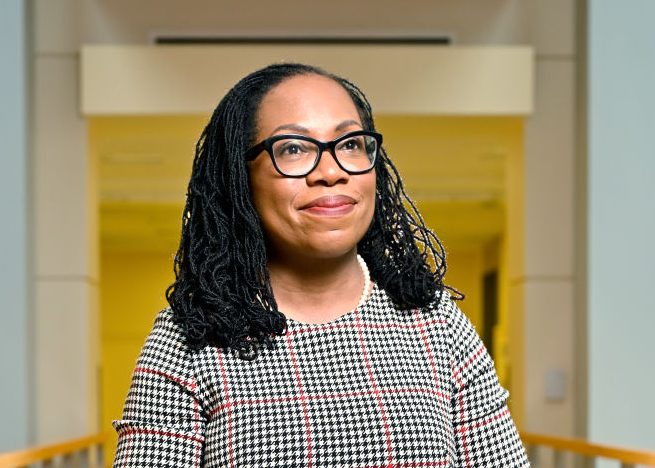
Trust in the Supreme Court has reached historic lows in recent years under its current 6-3 Republican supermajority. This is largely fueled by the perception that the court is more concerned about serving the GOP agenda than the American people. While Chief Justice John Roberts has lamented that the court is seen as political, Justice Ketanji Brown Jackson has said that the court’s recent decision on the Voting Rights Act only reinforces that perception.
According to AP, Justice Jackson made her comments while speaking at the American Law Institute’s annual meeting in Washington, D.C. “It is so important for the public to perceive us as neutral, nonpartisan,” because “public confidence is really all the judiciary has. That’s our currency,” Jackson said. “It’s incumbent upon us to do things, to act in ways that shore up public confidence.”
As a result of the Supreme Court voting 6-3 to effectively gut Section 2 of the Voting Rights Act, several Southern states have announced redistricting efforts that undermine Black voting power. Tennessee already passed a new map eliminating the state’s lone majority Black district, South Carolina is currently trying to pass a new congressional map eliminating the seat held by Rep. James Clyburn, and the Supreme Court paved the way for Alabama to use a congressional map that it previously found was racially gerrymandered.
Justice Jackson added that there are “real-world consequences that are occurring, and no one really has a clear sense of why it’s happening or what the court’s reasoning is. So I just think we can and should be better.”
There were already inklings of how the ruling had strained the court when Jackson wrote a solo dissent on the Supreme Court’s decision to bypass the traditional waiting period to allow Louisiana to trigger a redistricting effort while early voting for the state’s primary elections was underway. Jackson called out the court’s hypocrisy for previously chastising lower courts for ruling on maps a year ahead of the midterms, only to allow Republican state legislatures to draw new maps as early voting is underway.
“And just like that, those principles give way to power,” Jackson wrote in her dissent.
Justice Samuel Alito’s response revealed he and the other conservative justices were clearly pressed by Jackson’s dissent. “What principle has the Court violated?” Alito wrote. “The principle that Rule 45.3’s 32-day default period should never be shortened even when there is good reason to do so? The principle that we should never take any action that might unjustifiably be criticized as partisan?”
Just saying, the only time I’ve ever gotten that defensive was when I was young, dumb, and caught doing something I knew I had no business doing.
The New York Times reports that the Supreme Court’s conservative justices have continually lamented that their partisan rulings have been perceived as partisan. “At a very basic level, people think we’re making policy decisions,” Chief Justice Roberts said during a speaking engagement. “I think they view us as purely political actors, which I don’t think is an accurate understanding of what we do.”
Justice Amy Coney Barrett cosigned that point during a book talk at the George W. Bush Presidential Center in Dallas. “I think the casual reader about the Supreme Court or its decisions might have the impression we’re just kind of up there, politicians in robes. That’s not how the court functions, and I think if you listen to some oral arguments, you see what the court’s about,” she said.
Having read through some of their rulings, I still have the impression they’re acting like politicians in robes. Whether it’s the Dobbs decision or its ruling on the Voting Rights Act, the current Supreme Court has shown a willingness to re-litigate previously settled laws through an ideological lens. Amber Thurman is dead because of the Supreme Court’s partisan nature. Black people in Memphis are being denied proper congressional representation due to the Supreme Court’s partisan nature.
If the conservative justices are so in their feelings about being perceived as partisan, then maybe they should stop crafting partisan rulings.
SEE ALSO:
Supreme Court Justices Alito And Jackson Debate Voting Rights Decision
SCOTUS Callais Decision Delivers Major Blow To Black Voting Rights
Supreme Court Justice Ketanji Brown Jackson Critical Of Voting Rights Ruling was originally published on newsone.com