For Black Women, ‘Combative’ Is Media’s Favorite Dog Whistle
From Shirley Chisholm To Jasmine Crockett: ‘Combative’ Is Political Media’s Favorite Dog Whistle
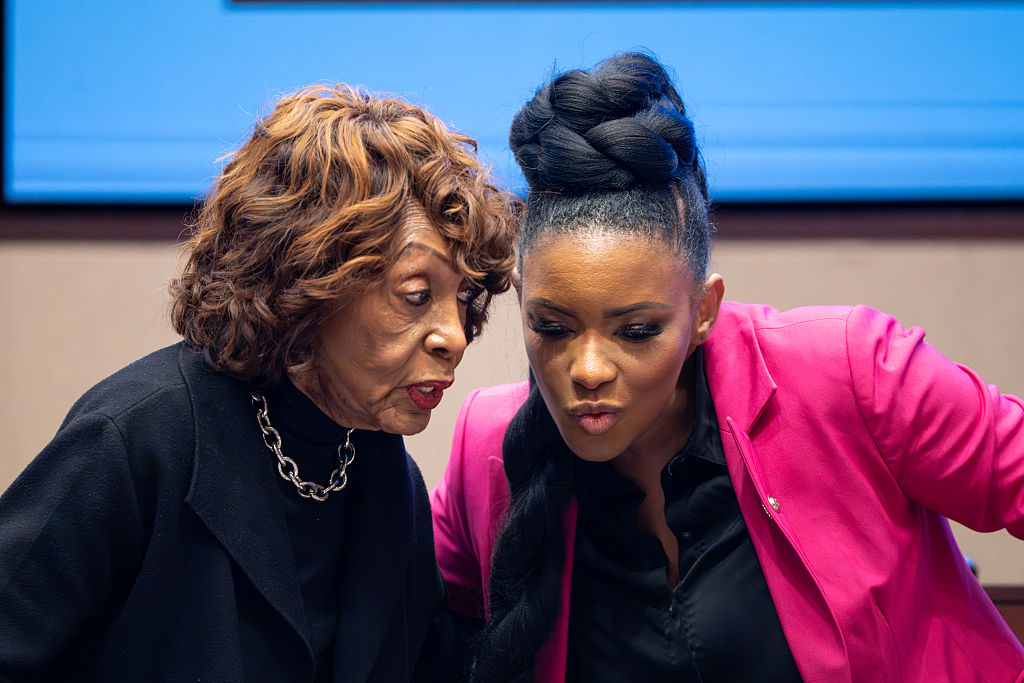
Texas Rep. Jasmine Crockett announced her U.S. Senate bid this week, and within hours, the political press did what it has long perfected when Black women reach for power. HuffPost and other outlets described her not by her platform, record, or strategy, but by her temperament, branding the first-term congresswoman as “combative.”
“Combative” is one of those respectable-sounding smear words clean enough for newsroom style guides and loaded enough to do racial and gendered damage without anyone having to say a Black woman is angry, aggressive, or out of control. When HuffPost calls Jasmine Crockett “the combative first-term congresswoman,” that adjective is ideological signaling. It primes the reader before they even get to her politics. You’re supposed to hear problematic, difficult, too much, not feminine, grateful, or deferential.
The language snapped into place almost immediately.
One headline announcing Jasmine Crockett’s Senate bid led not with her platform or electoral math, but with a personality tag, describing her as “the combative first-term congresswoman, a leading critic of Trump” in a write-up syndicated by Yahoo News. Another outlet reached for a familiar shorthand, calling her a “firebrand” in its announcement that Texas Rep. Jasmine Crockett launched a run for Senate.
A longer national profile published last summer went further, framing Crockett as a Democrat testing “the coarse style of politics that the GOP has embraced,” subtly recasting her rhetorical posture as an imitation of Republican excess rather than a response to a brutal political environment, as reported by the Atlantic. Local coverage leaned into the same groove, crediting her growing visibility to “fiery clashes” and “viral spats” that have helped turn her into a household name, language echoed in coverage by KFOX and reinforced in additional national commentary.
The framing isn’t entirely uniform, but that variation is revealing. More neutral outlets avoid “combative” altogether, opting instead for descriptors like “outspoken,” “bold,” or “direct.” Other outlets, often more hostile, sharpen the coverage into “diva” character critique, referencing internal staff complaints or leaning on gendered accusations.
Taken together, the pattern is unmistakable. “Combative” isn’t a stray adjective. It belongs to a familiar cluster: firebrand, fiery, confrontational, and abrasive. Whether those traits are framed as leadership or liability depends less on Crockett’s behavior than on the outlet doing the framing and the audience it imagines.
What’s especially telling is the timing. Crockett announces a Senate bid, stepping into serious power, and the descriptor shows up immediately. Not her record. Not her policy positions. Not her legal background. Not her effectiveness. Her tone. This is the same regulatory language that’s been used for centuries to discipline Black women who refuse softness as a survival strategy. It’s the plantation logic that says you may speak, but you may not sound like that.
And notice how unnecessary it is.
White male politicians who yell, threaten, insult colleagues, shut down governments, or storm hearings aren’t routinely described as “combative.” They’re “outspoken.” They’re “fighters.” They “don’t back down.” They’re “tough.” The same behavior, filtered through a Black woman’s body, suddenly becomes a temperament issue instead of a political stance.
White women occupy a middle tier in this hierarchy, and their treatment is contingent on alignment with white comfort and patriarchal norms.
When white women yell, insult colleagues, grandstand in hearings, or needle opponents, they are far less likely to be labeled “combative.” Instead, they’re framed through a softer but still gendered vocabulary. They’re “forceful.” “Blunt.” “Sharp.” “No-nonsense.” At worst, they might be called “ambitious” or “overzealous,” words that suggest excess energy rather than moral threat.
But the catch is that white women are granted legitimacy as long as they are seen as working within the system, not challenging it. Their assertiveness is tolerated, sometimes even praised, when it reinforces existing power, not when it exposes or destabilizes it.
Think about Liz Cheney. She has been openly confrontational and willing to torch her own party. She was framed as “principled,” “brave,” and “courageous,” even when she was ejected from leadership. Her discipline was ideological, not behavioral.
The media has routinely called Nancy Pelosi “tough,” “savvy,” or “a master legislator,” rarely “combative.” The loud, disruptive, and conspiratorial Marjorie Taylor Greene was often described as “extreme,” “unhinged,” or “provocative.” But notice the framing is ideological pathology or spectacle, not temperament policing in the same moralizing way it is for Black women.
Hillary Clinton is the exception that proves the rule. When she challenged male power directly, and especially when she sought the presidency, she was framed as cold, shrill, calculating, and unlikable. Still, even then, the language rarely crossed into the racialized register reserved for Black women. She was “unlikable,” but not dangerous.
White women in politics may be criticized, mocked, or disliked, but they are rarely framed as out of control. They are rarely treated as a bodily threat. Their anger is personalized or psychologized, but it is not read as an existential danger to the political order. The exact words used for white women (“strong,” “direct”) harden into warnings when applied to Black women (“combative,” “hostile,” “angry”).
What we’re witnessing is a familiar media reflex that attempts to warn the audience that this Black woman is not here to soothe them. And the fact that the word keeps resurfacing, again and again, in moment after moment when Black women claim authority, is precisely the point.
The adjective is familiar. From Shirley Chisholm to Barbara Jordan, Maxine Waters to Kamala Harris, Black women who challenge political norms have routinely been framed as aggressive, abrasive, or difficult—language that signals disruption rather than substance.
In Crockett’s case, “combative” functions less as a descriptor than a warning label, one that has historically appeared whenever Black women refuse performative softness and instead confront power directly. This has happened repeatedly across generations. And the pattern is so consistent that it functions less like commentary and more like a disciplinary script.
Shirley Chisholm was punished with language long before the word “combative” became newsroom shorthand.
From the moment she entered Congress in 1968 as the first Black woman elected, mainstream media struggled to place her anywhere except outside the bounds of acceptable femininity and political decorum. Rather than centering her policy positions like anti-war, pro-childcare, pro-education, and anti-poverty, the coverage fixated on her disposition.
Historians and media scholars who have examined coverage of Shirley Chisholm consistently note that reporting focused less on her policy agenda than on her demeanor and perceived disposition.
Contemporary news accounts and retrospective analyses alike describe a press environment that framed Chisholm as unusually forceful, disruptive, or difficult. This language functioned to mark her as outside the boundaries of acceptable political femininity rather than as a serious legislative actor. Her assertiveness was frequently interpreted as temperament, her independence read as obstinacy, and her refusal to defer to party leadership was cast not as principle but as insubordination. The commentary about her voice, manner, and style circulated far more readily than sustained engagement with her positions on war, childcare, education, or economic justice.
That framing sharpened dramatically during her 1972 presidential campaign, the first by a Black woman. Coverage routinely treated her candidacy as symbolic rather than viable, often characterizing it as aspirational, protest-oriented, or quixotic rather than strategic.
Political reporters and columnists questioned her seriousness, emphasized her marginal status within the Democratic Party, and presented her run as unrealistic or disruptive to party unity. In both tone and substance, Chisholm was rarely portrayed as a visionary or tactician, despite advancing a platform on racial justice, gender equality, and social welfare that would later move squarely into the Democratic mainstream. As multiple scholars have observed, the press response revealed less about the feasibility of her campaign than about the constraints placed on Black women who sought power beyond the roles the political establishment had already defined for them.
And here’s the key parallel to Jasmine Crockett: white male politicians at the time who behaved far more belligerently were framed as bold, maverick, or courageous, while Chisholm’s refusal to soften herself was treated as a personality defect. The issue was never her ideas; it was her refusal to perform gratitude, silence, or deference.
Chisholm knew what was happening. She famously said, “I am not the candidate of Black America, although I am Black and proud. I am not the candidate of the women’s movement, although I am a woman and equally proud. I am the candidate of the people.” That insistence on self-definition directly challenged how the press wanted to contain her.
In hindsight, historians now describe her as principled, fearless, and prophetic. But that clarity only comes after the danger has passed. In real time, the media used coded language to warn audiences: this woman will not be managed.
Which is exactly what “combative” is doing now to describe Rep. Crockett.
Barbara Jordan was described as stern, unyielding, severe, and intimidating despite being one of the most measured, legally precise speakers in Congress. Her calm, deliberate cadence during Watergate was read not as authority but as coldness. White men delivering the same gravitas were called statesmanlike. Jordan was framed as inflexible, almost forbidding, as if moral clarity itself were a threat when it came from a Black woman.
Maxine Waters has spent decades being labeled angry, incendiary, divisive, unhinged, and confrontational. When she interrogates power, the coverage almost never centers on the substance of her critiques of Wall Street, police violence, and voter suppression. Instead, it circles her tone. Even her nickname, “Auntie Maxine,” emerged as a way to contain and domesticate someone the media otherwise portrays as perpetually on the verge of eruption.
Carol Moseley Braun, the first Black woman elected to the U.S. Senate, was described as temperamental, difficult, erratic, and “hard to work with.” Her policy disagreements were regularly psychologized. Where white male senators were “principled holdouts,” she was framed as unstable or overly emotional. Coverage often suggested she was her own worst enemy, not that she was navigating a Senate openly hostile to her presence.
Kamala Harris, before the presidential campaign, was routinely described as aggressive, overly ambitious, sharp-elbowed, and calculating. During debates, her prosecutorial questioning was treated as excessive or mean-spirited. Even her facial expressions were pathologized. She smiled too much. She didn’t smile enough. She pressed too hard. She laughed “wrong.”
Stacey Abrams has been labeled abrasive, bossy, insistent, and refusing to concede. This is language that quietly recasts constitutional disputes over voter suppression as a personal temperament flaw. Her refusal to disappear politely after voter disenfranchisement was treated as emotional instability rather than civic resistance.
Even Michelle Obama, who scrupulously avoided direct political confrontation for years, was framed as angry, emasculating, militant, and resentful. Her very seriousness, her refusal to perform cheerfulness for white consumption at all times, was taken as hostility.
What matters isn’t any single word, whether it is combative, angry, strident, divisive, or abrasive. It’s the function. These labels don’t describe behavior; they police boundaries. They warn audiences that this Black woman does not prioritize white comfort, does not soften her authority, does not apologize for occupying space.
And just like Shirley Chisholm, history eventually rewrites them as courageous, prophetic, and ahead of their time. The language only softens once the threat recedes.
Jasmine Crockett isn’t being uniquely described. She’s being placed correctly within a long lineage of Black women whose clarity, refusal, and political audacity had to be reframed as temperament problems so that the power structure wouldn’t have to answer their arguments.
And here’s the thing—Black women in politics are angry. We are combative. Because the stakes are high. If you can look around at all the meanness and evil and cruelty going down in this country right now and not feel anger, then something is wrong with you.
Black women do not arrive in politics through gentleness alone. We do not survive centuries of sanctioned violence, racial terror, stolen children, stolen labor, voter disenfranchisement, and gendered exclusion by being agreeable or palatable. We survive by resisting and confronting. By refusing to perform calm while our rights are being dismantled and lives are being erased in real time.
So when the media labels Black women leaders “angry” or “combative,” it is not diagnosing a flaw in character; it is registering a refusal to submit. “Combative” in this context is not a temperament issue; it is a political posture. It is what civic engagement looks like when the system itself is hostile. It is what democracy sounds like when those most harmed decline to whisper.
Dr. Stacey Patton is an award-winning journalist and author of “Spare The Kids: Why Whupping Children Won’t Save Black America” and the forthcoming “Strung Up: The Lynching of Black Children In Jim Crow America.” Read her Substack here.
SEE ALSO:
Texas Tough: Rep. Jasmine Crockett Officially Launches US Senate Run
Fox Hates Jasmine Crockett Because She’s A Smart Black Woman
From Shirley Chisholm To Jasmine Crockett: ‘Combative’ Is Political Media’s Favorite Dog Whistle was originally published on newsone.com


